
Current Status of World’s Third Largest Meteoritic Crater - Lonar Lake, India
Keywords:
Current status, Meteoritic crater, Lonar Lake, Physico-chemical parametersAbstract
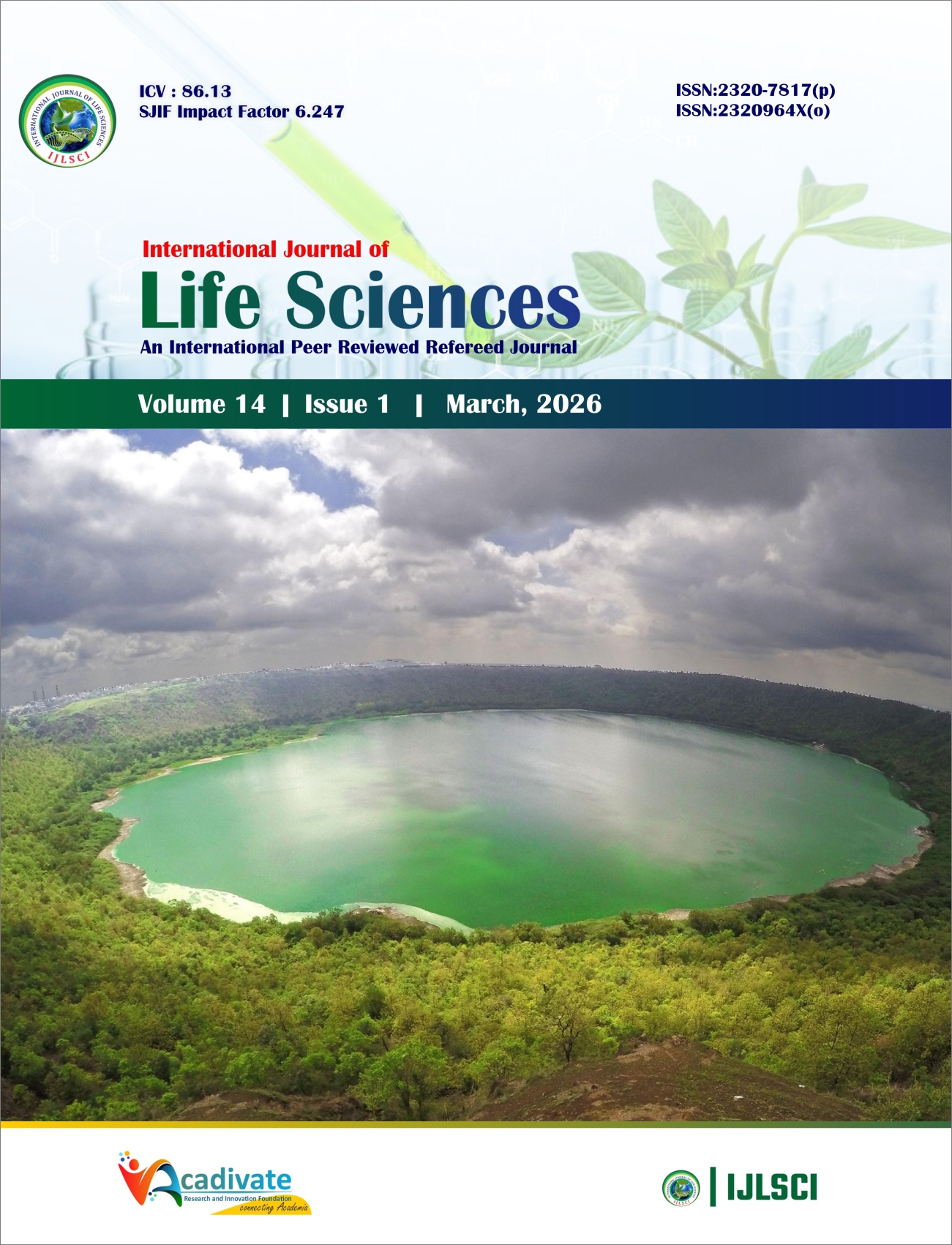
Lonar Lake, the world’s third largest meteorite crater, is located in the Buldhana district of Maharashtra, India. It is the only saline water body of its kind in the world. The lake is nestled within a circular depression, surrounded by steep escarpments formed by an ejecta blanket. One of its most distinctive features is that it has an inlet but no outlet, which has led to its unusual and climate-driven isolation. Before 1985, the lake would dry up completely each summer, leaving behind a crust of salt along its shores. Local residents of Lonar town would collect this salt for making papads and washing clothes. During a study conducted between 1999 and 2004, the lake’s water level rose by about six feet. Since then, the water level has continued to climb steadily. Today (2026), the situation has become alarming—the water level has risen by more than 20 feet compared to earlier records. This significant increase has drastically altered the lake’s physico-chemical conditions, which in turn is affecting the biodiversity of the lake and its surrounding area.
Downloads
References
1. APHA. (1998). Standard Methods for the Examination of Water and Wastewater. 20th Edition. American Public Health Association, Washington, D.C.
2. Chandrasekharam, D., Singh, A. and Patel, R. (2021). Hydrological changes in Lonar Crater Lake: Role of anthropogenic and climatic factors. Journal of Indian Geohydrology, 42(3): 215-230.
3. Dabhade, D.S. (2015). Lonar Saline Lake, India – A case study. International Journal of Research in Biosciences, 3(2): 249-251.
4. Deshmukh, A. and Ranade, P. (2023). Microbial diversity loss in Lonar Lake under freshwater dilution stress. Indian Journal of Microbiology, 61(4): 412-425.
5. Deshpande, R.P. (2004). Study on Ecological Characteristics and the Fauna of Lonar Lake. Ph.D. Thesis, Swami Ramanad Teerth Marathwada University, Nanded.
6. Fredriksson, K., Dube, A., Milton, D.J. and Balasundaram, M.S. (1973). Lonar Lake, India: An impact crater in basalt. Science, 180(4088): 862-864.
7. Godbole, A., Raut, S. and Deshpande, V. (2021). Historical references to Lonar Lake in medieval Indian texts. Indian Journal of History of Science, 56(2): 98-110.
8. Hammer, U.T. (2021). Saline Lake Ecosystems of the World. Springer, Dordrecht.
9. Joshi, P. and Pappu, S. (2015). Temple architecture around Lonar Crater: A cultural heritage assessment. Heritage India, 8(1): 34-47.
10. Kodarkar, M.S. (1998). Methodology for Water Analysis. Indian Association of Aquatic Biologists Publication, Hyderabad.
11. Maloof, A.C., Stewart, S.T., Weiss, B.P., Soule, S.A., Swanson-Hysell, N.L., Louzada, K.L., and Poussart, P.M. (2010). Geology of Lonar Crater, India. Geological Society of America Bulletin, 122(1-2): 109-126.
12. Mishra, S., Mishra, D.R. and Lee, Z. (2019). Bio-optical properties of Lonar Lake: A hypersaline-alkaline crater lake. Remote Sensing of Environment, 221: 551-564.
13. Patil, R. and Kulkarni, S. (2022). Submergence of heritage structures around Lonar Lake: A preliminary assessment. Journal of Cultural Heritage Management, 12(4): 301-315.
14. Ramsar Convention. (2020). Ramsar Sites Information Service – Lonar Lake. Ramsar Secretariat, Gland.
15. Upadhyay, A., Singh, P.K. and Shrivastava, J.N. (2020). Impact of declining salinity on haloalkaliphilic microbial communities of Lonar Lake. Extremophiles, 24(5): 735-748.
16. Wani, A.A., Khan, I. and Sheikh, Z. (2022). Climate-induced hydrological changes in Maharashtra's crater lakes. Climate and Development, 14(7): 642-655.
17. Williams, W.D. (2019). African and Asian Saline Lakes. Backhuys Publishers, Leiden.
Downloads
Published
How to Cite
Issue
Section
License
Copyright (c) 2026 Author

This work is licensed under a Creative Commons Attribution-NonCommercial-NoDerivatives 4.0 International License.
Open Access This article is licensed under a Creative Commons Attribution 4.0 International License, which permits use, sharing, adaptation, distribution and reproduction in any medium or format, as long as you give appropriate credit to the original author(s) and the source, provide a link to the Creative Commons license, and indicate if changes were made. The images or other third party material in this article are included in the article’s Creative Commons license unless indicated otherwise in a credit line to the material. If the material is not included in the article’s Creative Commons license and your intended use is not permitted by statutory regulation or exceeds the permitted use, you will need to obtain permission directly from the copyright holder. To view a copy of this license, visit http://creativecommons.org/ licenses/by/4.0/
















