
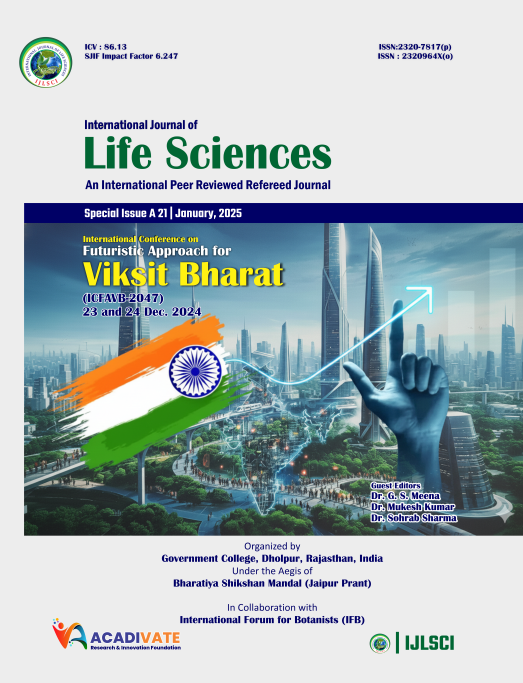
Futuristic Approach for Viksit Bharat: With Special Context of Reinstatement of Industrial Workers
Keywords:
Viksit Bharat, Industrial Workers, Futuristic Approach, Industry 4.0, Re skilling, Up skilling, Automation, Workforce ReintegrationAbstract
The concept of a "Viksit Bharat" (Developed India) demands a comprehensive strategy for socio-economic development, with a particular focus on the critical role of industrial workers in the nation’s growth. The industrial workforce, which forms the backbone of India’s economic engine, has faced numerous challenges, including poor working conditions, wage inequalities, job insecurity, and gender disparities. As India aspires to become a global economic powerhouse, addressing the needs and welfare of industrial workers becomes paramount, particularly in the context of rapidly evolving technologies and economic structures. These technologies can increase productivity and reduce the physical toll on workers, while creating opportunities for new, skill-based jobs. A significant aspect of this futuristic approach is addressing the gender imbalance in the industrial sector. Women industrial workers often face marginalization, unequal pay, and unsafe working environments. Future strategies must focus on creating inclusive policies that promote gender equality, ensure equal pay for equal work, and safeguard women’s rights in industrial settings. The implementation of these measures will help create a sustainable workforce that contributes to the overall vision of a "Viksit Bharat." In conclusion, the reinstatement and development of industrial workers, particularly with attention to gender equality and socio-economic security, is essential to achieving India’s aspirations for a prosperous and just future.
Moreover, the paper underscores the importance of robust social security frameworks to mitigate job displacement risks and ensure economic stability during transitions. Initiatives such as digital literacy campaigns, vocational training, and skill mapping are proposed to empower industrial workers and align them with futuristic job roles.
Downloads
References
1. Berg L, Lichtenstein G (2019) The Impact of Automation on Employment in India's Industrial Sector. World Development 118: 95-109.
2. Chand R, Kumar S (2019) Labor Laws in India: A Critical Review of Recent Reforms. International Journal of Law and Economics 45(1): 54-67.
3. Chandra M, Kumar A (2021) The Role of Corporate Social Responsibility in Shaping India's Industrial Workforce. Journal of Business Ethics 74(3): 400-415.
4. Chaudhary P (2021) Automation and Its Effects on Labor Market: Case Study of Indian Manufacturing Sector. Industrial Relations Journal 32(3): 128-144.
5. Das R (2019) Labor Market Transformation and Reskilling for India's Future Workforce. Journal of Human Resource Management 42(3): 115-130.
6. Government of India (2020) The New Labor Codes and Their Impact on Industrial Workers. Ministry of Labor and Employment. Available at: www.labour.gov.in
7. Goyal M, Verma R (2020) India's Industrialization and Workers' Rights: A Developmental Perspective. Asian Journal of Social Science 28(2): 222-238.
8. ILO (2019) World Employment and Social Outlook 2019: The Future of Work. International Labour Organization. Available at: www.ilo.org
9. Kumar S, Rathi S (2020) Promoting Gender Equality in the Industrial Sector: A Policy Approach for India. Indian Journal of Public Administration 66(2): 230-245.
10. Narayan J, Chattopadhyay S (2020) The Role of Automation in Industrial Workforce Displacement in India. Economic and Political Weekly 55(45): 43-47.
11. Patel R (2021) Industrialization and Women's Workforce Participation in India: Challenges and Opportunities. Indian Journal of Economics and Development 16(1): 51-64.
12. Rathi S (2020) The Digital Economy and Reskilling for Industrial Workers in India: A Comprehensive Review. Journal of Digital Transformation 12(1): 98-111.
13. Sahoo S, Mishra S (2021) Technological Innovation and Its Impact on the Indian Workforce. International Journal of Technology and Management 17(2): 123-136.
14. Sharma P, Gupta A (2018) Gender and Labor Market: Challenges for Women in the Industrial Workforce in India. Gender, Technology and Development 22(1): 18-34.
15. Singh H, Bhat A (2022) Improving Gender Equality in Indian Industries: The Role of Labor Laws and Policies. Indian Journal of Labor Economics 63(4): 710-725.
16. Singh R (2020) Industrial Workers and Labor Reforms in India. Journal of Labor and Industrial Relations 32(4): 101-118.
17. Tiwari A, Dutt S (2020) Reimagining Industrial Workforces: The Case of India in the 21st Century. Development Policy Review 38(4): 489-510.
18. United Nations Industrial Development Organization (2021) India's Industrialization and Social Transformation: Opportunities and Challenges. UNIDO Report.
19. World Economic Forum (2020) The Future of Jobs Report 2020. Available at: www.weforum.org
20. Zachariah R, Mathew K (2020) Social Security for Industrial Workers: A Critical Review of Existing Systems and Future Needs. International Journal of Social Security 28(1): 45-58.
Downloads
Published
How to Cite
Issue
Section
License
Copyright (c) 2025 Author

This work is licensed under a Creative Commons Attribution-NonCommercial-NoDerivatives 4.0 International License.
Open Access This article is licensed under a Creative Commons Attribution 4.0 International License, which permits use, sharing, adaptation, distribution and reproduction in any medium or format, as long as you give appropriate credit to the original author(s) and the source, provide a link to the Creative Commons license, and indicate if changes were made. The images or other third party material in this article are included in the article’s Creative Commons license unless indicated otherwise in a credit line to the material. If the material is not included in the article’s Creative Commons license and your intended use is not permitted by statutory regulation or exceeds the permitted use, you will need to obtain permission directly from the copyright holder. To view a copy of this license, visit http://creativecommons.org/ licenses/by/4.0/
















