
Beetles (Insecta: Coleoptera) as Bioindicators for the Assessment of Environmental Pollution
DOI:
https://doi.org/10.66167/ijlsci/2025113317Keywords:
Bioindicator, Environmental pollution, Ecological assessment, Ecosystem health, Sentinel species, Jewel beetles, Insect biomarkersAbstract
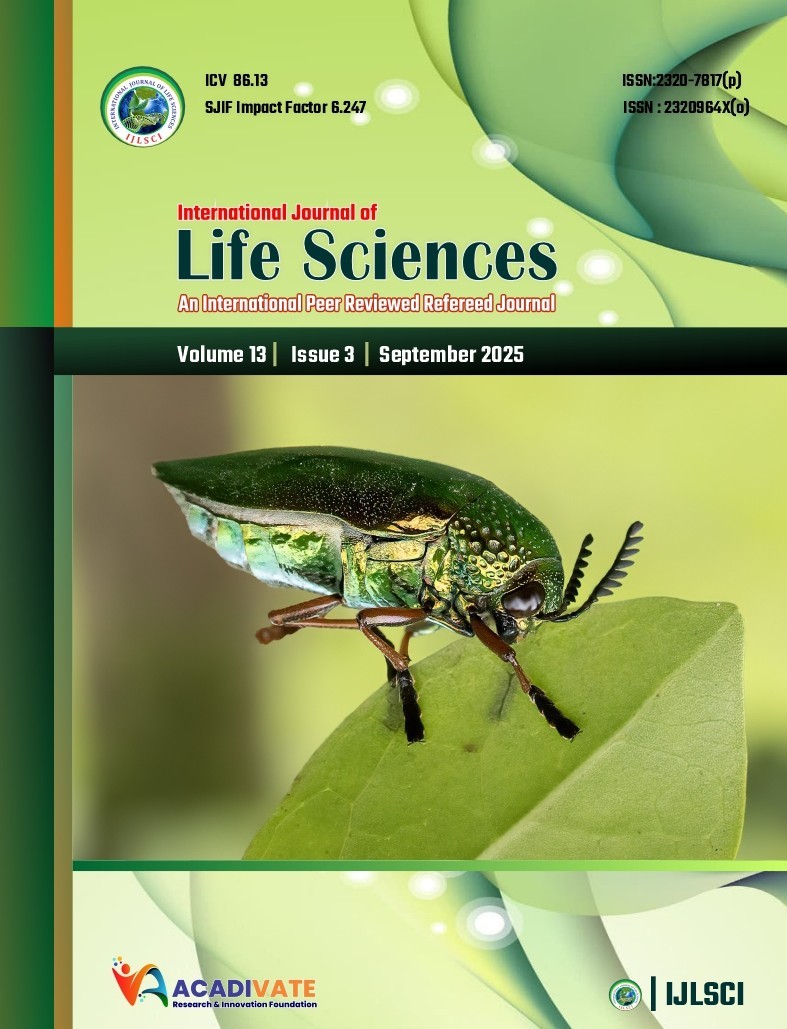
Environmental pollution poses a significant threat to global ecosystems and human health, creating an urgent need for effective biomonitoring tools. Coleoptera, representing the most diverse insect order, has emerged as a valuable taxon for pollution assessment due to its ecological versatility and sensitivity. This comprehensive review synthesizes current knowledge on the use of beetles as bioindicators for a spectrum of environmental pollutants, including heavy metals, pesticides, microplastics, and the cascading effects of climate change.
Methods: We analyzed a wide range of studies employing beetles to monitor pollution levels across different ecosystems, examining evidence from accumulation patterns, behavioural and physiological changes, and community-level shifts. Research demonstrates that beetles effectively indicate pollution intensity through measurable responses. Ground beetles (Carabidae) show pollution intensity-dependent metal accumulation, while other families provide insights into emerging contaminants and climatic shifts. Their ecological traits, such as trophic position and habitat specificity, make them powerful sentinels. Beetles provide a reliable, cost-effective means for environmental assessment. However, the standardization of methods, a deeper understanding of long-term implications, and the integration of modern genetic tools are critical areas for future research. Their formal inclusion in monitoring frameworks offers a promising pathway for comprehensive environmental health evaluation.
Downloads
References
Bentz, BJ, Régnière, J, Fettig, CJ, Hansen, EM, Hayes, JL, Hicke, JA, Kelsey, RG, Negrón, JF, & Seybold, SJ (2010). Climate change and bark beetles of the western United States and Canada: Direct and indirect effects. BioScience, 60(8), 602–613. https://doi.org/10.1525/bio.2010.60.8.6
Bohac, J (1999). Staphylinid beetles as bioindicators. Agriculture, Ecosystems & Environment, 74(1-3), 357–372. https://doi.org/10.1016/S0167-8809(99)00043-2
Brose, U (2003). Bottom-up control of carabid beetle communities in early successional wetlands: Mediated by vegetation structure or plant diversity? Oecologia, 135(3), 407–413. https://doi.org/10.1007/s00442-003-1195-6
Buteler, M, Alma, AM, Stadler, T, & Gingold, R (2015). Trace element accumulation in three carabid species: A review. Ecotoxicology, 24(9), 1833–1843. https://doi.org/10.1007/s10646-015-1524-7
Buteler, M, ... [et al.] (2023). Management practice for small hive beetle as a source of microplastic contamination in honey and honeybee colonies. Environmental Pollution, 334, 122151. https://doi.org/10.1016/j.envpol.2023.122151
Caro, TM (2010). Conservation by proxy: Indicator, umbrella, keystone, flagship, and other surrogate species. Island Press.
Caro, TM, & O'Doherty, G (1999). On the use of surrogate species in conservation biology. Conservation Biology, 13(4), 805–814. https://doi.org/10.1046/j.1523-1739.1999.98338.x
Colwell, RK, Brehm, G, Cardelus, CL, Gilman, AC, & Longino, JT (2008). Global warming, elevational range shifts, and lowland biotic attrition in the wet tropics. Science, 322(5899), 258–261. https://doi.org/10.1126/science.1162547
da Silva, PG, ... [et al.] (2020). Elevational specialization and the monitoring of the effects of climate change. Ecological Indicators, 119, 106849. https://doi.org/10.1016/j.ecolind.2020.106849
Desneux, N, Decourtye, A, & Delpuech, JM (2007). The sublethal effects of pesticides on beneficial arthropods. Annual Review of Entomology, 52, 81–106. https://doi.org/10.1146/annurev.ento.52.110405.091440
Gerhardt, A (2002). Bioindicator species and their use in biomonitoring. In Environmental monitoring (Vol. 1, pp. 77–123). Eolss Publishers.
Gerlach, J, Samways, M, & Pryke, J (2013). Terrestrial invertebrates as bioindicators: An overview of available taxonomic groups. Journal of Insect Conservation, 17(4), 831–850. https://doi.org/10.1007/s10841-013-9565-9
Gossner, MM, ... [et al.] (2016). A summary of eight traits of Coleoptera, Hemiptera, Orthoptera and Araneae, occurring in grasslands in Germany. Scientific Data, 3, 160094. https://doi.org/10.1038/sdata.2016.94
Hanks, LM (1999). Influence of the larval host plant on reproductive strategies of cerambycid beetles. Annual Review of Entomology, 44, 483–505. https://doi.org/10.1146/annurev.ento.44.1.483
Hodkinson, ID, & Jackson, JK (2005). Terrestrial and aquatic invertebrates as bioindicators for environmental monitoring, with particular reference to mountain ecosystems. Environmental Management, 35(5), 649–666. https://doi.org/10.1007/s00267-004-0211-x
Holland, JM, & Luff, ML (2000). The effects of agricultural practices on Carabidae in temperate agroecosystems. Integrated Pest Management Reviews, 5(2), 109–129. https://doi.org/10.1023/A:1009619309424
Ji, Y, Ashton, L, Pedley, SM, Edwards, DP, Tang, Y, Nakamura, A, ... & Larsen, TH (2013). Reliable, verifiable and efficient monitoring of biodiversity via metabarcoding. Ecology Letters, 16(10), 1245–1257. https://doi.org/10.1111/ele.12162
Jolivet, P (1994). Host-plants of the Chrysomelidae of the world: An essay about the relationships between the leaf-beetles and their food-plants. Backhuys Publishers.
Koivula, MJ (2011). Useful model organisms, indicators, or both? Ground beetles in ecological research. ZooKeys, 100, 287–317. https://doi.org/10.3897/zookeys.100.1533
Kotze, DJ, ... [et al.] (2011). Forty years of carabid beetle research in Europe – from taxonomy, biology, ecology and population studies to bioindication, habitat assessment and conservation. ZooKeys, 100, 55–148. https://doi.org/10.3897/zookeys.100.1523
Kromp, B (1999). Carabid beetles in sustainable agriculture: A review on pest control efficacy, cultivation impacts and enhancement. Agriculture, Ecosystems & Environment, 74(1-3), 187–228. https://doi.org/10.1016/S0167-8809(99)00037-7
Kurz, WA, Dymond, CC, Stinson, G, Rampley, GJ, Neilson, ET, Carroll, AL, ... & Safranyik, L (2008). Mountain pine beetle and forest carbon feedback to climate change. Nature, 452(7190), 987–990. https://doi.org/10.1038/nature06777
Lagisz, M, & Laskowski, R (2008). Evidence for between-generation effects in carabids exposed to heavy metals pollution. Ecotoxicology, 17(1), 59–66. https://doi.org/10.1007/s10646-007-0173-x
Lövei, GL, & Sunderland, KD (1996). Ecology and behavior of ground beetles (Coleoptera: Carabidae). Annual Review of Entomology, 41, 231–256. https://doi.org/10.1146/annurev.en.41.010196.001311
Maryanski, M, Kramarz, P, Laskowski, R, & Niklinska, M (2002). Decreased energetic reserves, morphological changes and accumulation of metals in carabid beetles (Poecilus cupreus L.) exposed to zinc- or cadmium-contaminated food. Ecotoxicology, 11(2), 127–139. https://doi.org/10.1023/A:1014425113481
McGeoch, MA (1998). The selection, testing and application of terrestrial insects as bioindicators. Biological Reviews, 73(2), 181–201. https://doi.org/10.1111/j.1469-185X.1997.tb00029.x
Meacci, S, & Orsini, M (2022). A pilot study to assess carabids as potential bioindicators of microplastics contamination in soils. Science of The Total Environment, 838, 156026. https://doi.org/10.1016/j.scitotenv.2022.156026
Nichols, E, ... [et al.] (2008). Ecological functions and ecosystem services provided by Scarabaeinae dung beetles. Biological Conservation, 141(6), 1461–1474. https://doi.org/10.1016/j.biocon.2008.04.011
Noss, RF (1990). Indicators for monitoring biodiversity: A hierarchical approach. Conservation Biology, 4(4), 355–364. https://doi.org/10.1111/j.1523-1739.1990.tb00309.x
Qiu, T, ... [et al.] (2023). Habitat will dictate whether ground beetles win or lose against climate change. Global Change Biology, 29(11), 2945–2957. https://doi.org/10.1111/gcb.16668
Raffa, KF, Aukema, BH, Bentz, BJ, Carroll, AL, Hicke, JA, Turner, MG, & Romme, WH (2008). Cross-scale drivers of natural disturbances prone to anthropogenic amplification: The dynamics of bark beetle eruptions. BioScience, 58(6), 501–517. https://doi.org/10.1641/B580607
Rainio, J, & Niemelä, J (2003). Ground beetles (Coleoptera: Carabidae) as bioindicators. Biodiversity & Conservation, 12(3), 487–506. https://doi.org/10.1023/A:1022412617568
Samways, MJ, McGeoch, MA, & New, TR (2010). Insect conservation: A handbook of approaches and methods. Oxford University Press.
Steffen, W, Richardson, K, Rockström, J, Cornell, SE, Fetzer, I, Bennett, EM, ... & Sörlin, S (2015). Planetary boundaries: Guiding human development on a changing planet. Science, 347(6223), 1259855. https://doi.org/10.1126/science.1259855
Stork, NE (2018). How many species of insects and other terrestrial arthropods are there on Earth? Annual Review of Entomology, 63, 31–45. https://doi.org/10.1146/annurev-ento-020117-043348
Sueur, J, Pavoine, S, Hamerlynck, O, & Duvail, S (2008). Rapid acoustic survey for biodiversity appraisal. PLoS One, 3(12), e4065. https://doi.org/10.1371/journal.pone.0004065
Thiele, HU (1977). Carabid beetles in their environments: A study on habitat selection by adaptations in physiology and behaviour. Springer-Verlag.
Thomsen, PF, & Willerslev, E (2015). Environmental DNA – An emerging tool in conservation for monitoring past and present biodiversity. Biological Conservation, 183, 4–18. https://doi.org/10.1016/j.biocon.2014.11.019
Tőzsér, D, ... [et al.] (2019). Pollution intensity-dependent metal accumulation in ground beetles: A meta-analysis. Environmental Science and Pollution Research, 26(31), 32092–32102. https://doi.org/10.1007/s11356-019-06403-4
Tscharntke, T, Tylianakis, JM, Rand, TA, Didham, RK, Fahrig, L, Batáry, P, ... & Westphal, C (2012). Landscape moderation of biodiversity patterns and processes—eight hypotheses. Biological Reviews, 87(3), 661–685. https://doi.org/10.1111/j.1469-185X.2011.00216.x
Turner, W (2014). Sensing biodiversity. Science, 346(6207), 301–302. https://doi.org/10.1126/science.1256014
Ulrich, W, Buszko, J, & Czarnecki, A (2004). Habitat association and distribution of carabid beetles in a managed forest landscape. Ecography, 27(5), 557–567. https://doi.org/10.1111/j.0906-7590.2004.03949.x
Woodcock, BA (2005). Pitfall trapping in ecological studies. In Insect sampling in forest ecosystems (pp. 37-57). Blackwell Science Ltd.
Downloads
Published
How to Cite
Issue
Section
License
Copyright (c) 2025 Authors

This work is licensed under a Creative Commons Attribution-NonCommercial-NoDerivatives 4.0 International License.
Open Access This article is licensed under a Creative Commons Attribution 4.0 International License, which permits use, sharing, adaptation, distribution and reproduction in any medium or format, as long as you give appropriate credit to the original author(s) and the source, provide a link to the Creative Commons license, and indicate if changes were made. The images or other third party material in this article are included in the article’s Creative Commons license unless indicated otherwise in a credit line to the material. If the material is not included in the article’s Creative Commons license and your intended use is not permitted by statutory regulation or exceeds the permitted use, you will need to obtain permission directly from the copyright holder. To view a copy of this license, visit http://creativecommons.org/ licenses/by/4.0/
















