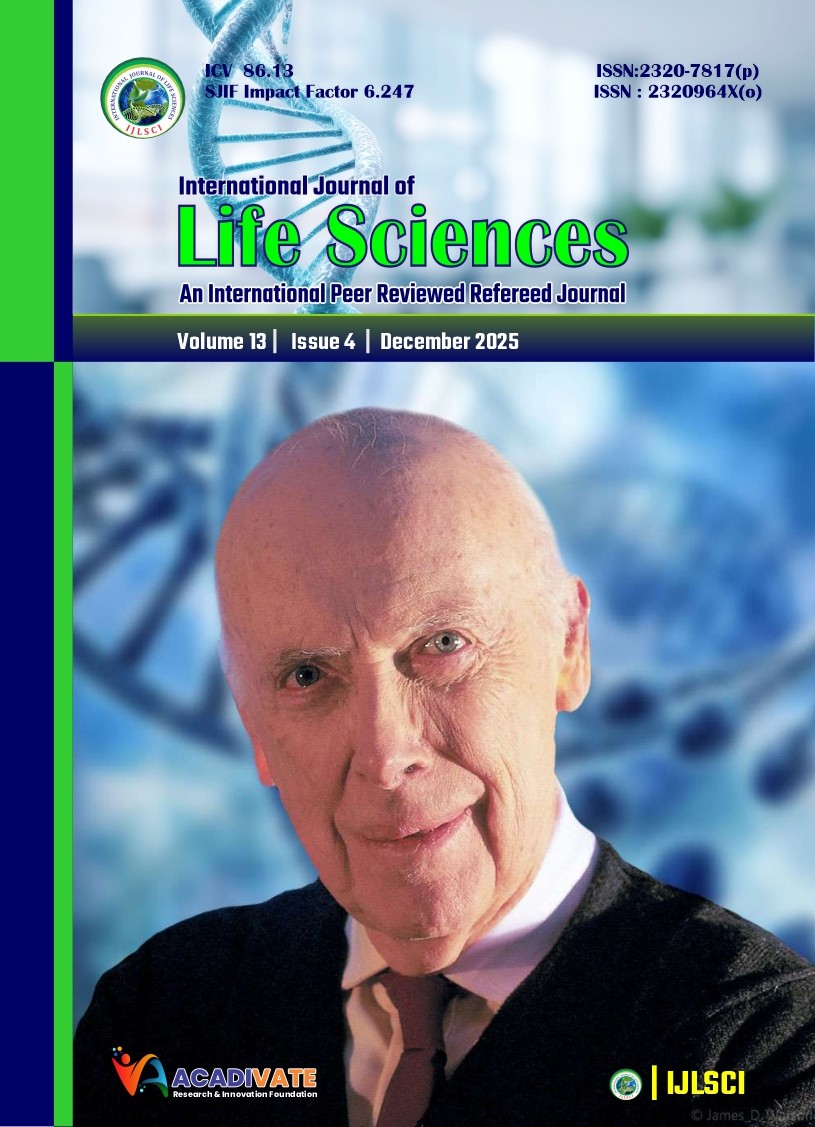
James Watson (1928-2025): A Double-Helix Legacy of Brilliance and Controversy
DOI:
https://doi.org/10.66167/ijlsci/2025114351Abstract
The passing of the co-discoverer of DNA’s structure forces the scientific community to confront a legacy of unparalleled achievement and profound controversy, a man who shaped modern biology and was then shunned by it.
American geneticist who shared a Nobel Prize for discovering the double helix structure of DNA. Born on April 6, 1928 in Chicago, IL, USA, he died aged 97 years in East Northport on Long Island, NY, USA, on Nov 6, 2025.
he scientific world marks the passing of an icon. James Dewey Watson, the visionary yet contentious co-discoverer of the double-helix structure of DNA, died on November 6, 2025, in East Northport, New York, at the age of 97. His death closes the final chapter on one of the most monumental—and complex—lives in 20th-century science. Watson’s work laid the very foundation for modern molecular biology and genetics, yet his later years were defined by reprehensible comments that alienated him from the community he helped build . His legacy is, therefore, not one to be simply eulogized, but one that must be critically examined in its entirety—a double helix of brilliance and ignominy forever intertwined.
The Landmark Discovery: Unveiling the "Secret of Life"
In 1953, a young and ambitiously brash James Watson, then only 25, collaborated with Francis Crick at the University of Cambridge’s Cavendish Laboratory to solve the structure of deoxyribonucleic acid (DNA). Their proposal of the double-helix model was a masterpiece of scientific inference, revealed in a paper in Nature on April 25, 1953. The elegant structure—two strands coiled around each other like a twisted ladder, with base pairs forming the rungs—immediately revealed the fundamental mechanisms of heredity: how genetic information is stored and, crucially, how it is replicated when cells divide.
This breakthrough was the culmination of a competitive race, informed by the critical work of others. As history has since rightly emphasized, pivotal X-ray diffraction data, including the famous "Photograph 51," came from the work of Rosalind Franklin and her student Raymond Gosling at King's College London. Maurice Wilkins, who also worked at King's, showed this crucial data to Watson, fueling the model-building efforts of the Cambridge duo. The 1962 Nobel Prize in Physiology or Medicine was subsequently awarded to Watson, Crick, and Wilkins. Franklin, whose data was so instrumental, had died in 1958 and was thus ineligible for the award. Watson would later compound this injustice with his unkind and sexist portrayal of Franklin in his 1968 bestselling memoir, The Double Helix, a candid and controversial account that broke conventions but was criticized for its depiction of colleagues, particularly Franklin.
A Scientific Leader and Visionary Architect
Beyond the double helix, significant leadership and an uncanny sense for the next big problem in biology marked Watson’s career. He played a key role in building the Cold Spring Harbor Laboratory (CSHL) on Long Island into a world-leading research center for molecular biology, neurobiology, and cancer research. Taking over as director in 1968 when the institution was financially endangered, he vigorously revitalized it, steering its focus toward tumor virology and cancer genetics, which led to our modern understanding of oncogenes. Under his direction for decades, the laboratory became a powerhouse, attracting thousands of scientists from around the globe.
Furthermore, Watson’s advocacy was instrumental in launching the Human Genome Project, and he served as its first director at the National Institutes of Health from 1989 to 1992. He championed the project’s bold goal to sequence the entire human genetic code and famously argued for its data to be made freely and immediately available to all, a stance that prevented the patenting of human genes and accelerated progress in genomics. His influential textbook, Molecular Biology of the Gene, first published in 1965, reinvented how the subject was taught and attracted generations of students to the field.
The Troubled Legacy: A Fall from Grace
For all his scientific genius, James Watson’s career was tragically marred by a long pattern of bigoted and scientifically unfounded statements about race, gender, and intelligence. In 2007, he publicly claimed that he was "inherently gloomy about the prospect of Africa" because "all the testing says" that the intelligence of Black people is "not really" the same as that of whites. This led to his immediate suspension and forced retirement from his leadership role at CSHL. Despite an apology, he repeated similar views in a 2019 documentary, prompting the laboratory to sever all ties with him and revoke his honorary titles, stating his comments were "reprehensible, unsupported by science".
These views were not isolated incidents but part of a deeply held belief system that stood in stark contradiction to his role in a scientific field that has proven the genetic unity of humankind . Colleagues and friends were often left baffled, tracing this shift to a hubris born of his early success and an overreliance on his own intuition, which he came to trust more than empirical research . This aspect of his life cannot be separated from his scientific contributions; it actively harmed his reputation and alienated him from the scientific community, turning him into what he himself described as an "unperson".
CONCLUSION: WEIGHING THE HELIX
James Watson’s passing demands a nuanced reflection. He was a man of towering intellect and ambition whose curiosity unlocked the "secret of life" and set in motion a revolution that has transformed medicine, biology, and our very understanding of what it means to be human . His work at CSHL and on the Human Genome Project cemented his status as an architect of modern science.
Yet, to remember him only for these achievements would be an incomplete accounting. His legacy is irrevocably tainted by prejudice, a cautionary tale about how brilliance in one arena does not confer wisdom in others . As we continue to build upon the foundation he helped lay, his life reminds us that the pursuit of scientific knowledge must be coupled with a steadfast commitment to ethical integrity and social responsibility. The double helix endures as a symbol of life's complexity and beauty; the story of one of its discoverers reminds us that human character can be equally, if not more, complex. His death, as one obituary noted, marks the end of an epoch in biology, closing the final chapter on the "eighth day of creation" . How we choose to remember him will say as much about our own values as it does about his tumultuous life.
Downloads
Downloads
Published
How to Cite
Issue
Section
License
Copyright (c) 2025 Author

This work is licensed under a Creative Commons Attribution-NonCommercial-NoDerivatives 4.0 International License.
Open Access This article is licensed under a Creative Commons Attribution 4.0 International License, which permits use, sharing, adaptation, distribution and reproduction in any medium or format, as long as you give appropriate credit to the original author(s) and the source, provide a link to the Creative Commons license, and indicate if changes were made. The images or other third party material in this article are included in the article’s Creative Commons license unless indicated otherwise in a credit line to the material. If the material is not included in the article’s Creative Commons license and your intended use is not permitted by statutory regulation or exceeds the permitted use, you will need to obtain permission directly from the copyright holder. To view a copy of this license, visit http://creativecommons.org/ licenses/by/4.0/